I’ve heard from a few online commentators that many of our society’s ills stems from the selfishness of the Boomer generation. However, what if this wasn’t the full story?
We’ve all heard stories of naked furry smelly hippies drug-tripping to the Beatles and the Grateful Dead in the late 60’s and selfishly draft-dodging while focusing on themselves in the early 70s.
Not all twenty-somethings in that era should be painted with this brush. Just like today, it’s the loudest who are seen. But who created the framework the Boomers were standing upon?
Yes, many of the participants of the feminist movement, rock music and film iconography were in their 20s but they themselves didn’t build the things they consumed. They were guided, managed, and went on to build Nickelodeon Studios in the early 2000s. Very entertaining, but off-set, also very… problematic.
Folks are correctly judging the Boomer adults in the room of Millennial kids for shady actions, but no one’s looking at the Silent generation adults in the room of Boomer kids (admittedly in their 20s but still young) encouraging them to act they way they did.
Likewise, my childhood mental state was influenced by McDonaldland TV adverts and Sid and Marty Krofft Saturday morning shows, but it wouldn’t be fair to say my generation created the hippy trippy 70s. We did create the hippy trippy Ayahuasca interest from Joe Rogan though, so I’ll take that one.
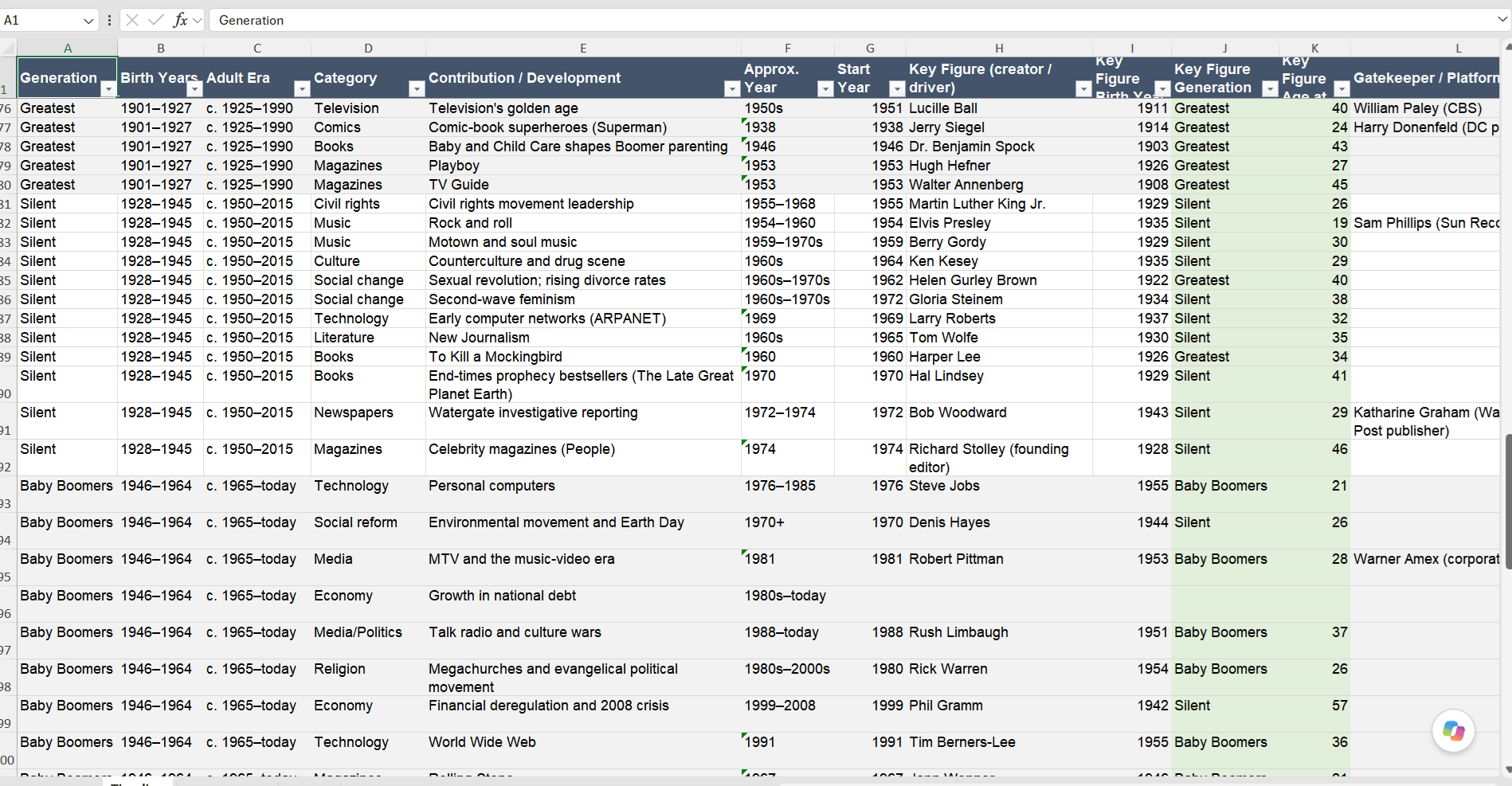
For reference, I’ve used rfab (Reality Fabricator) to create a tabbed workbook that lists the contributions by adult generation labels, not the consumers. This goes back to the 1700s. Unfortunately I had to switch to Claude AI since arfab started to get squirrely about generating the file for me.
I asked rfab to define an adult starting from age 26** instead of the legal age of 18. This is because although we can enter into legal agreements at age 18, we’re generally still not mature enough to make meaningful decisions until we’re older than 25 years. There are outliers of course, but automobile insurance rate schedules use mid-20s for a reason.
For instance, “Rock and roll and the folk revival” is generated by the the Silent generation. This means the Silent generation influenced music and film from 1955 to 1985. That rings true to me, having spent my teens and early 20s in the 80s. When I entered junior high, the “50s day” school dress-up thing was very very popular. When I graduated from high school in 1983, the Doobie Brothers and Cheech & Chong were still very popular. That was culture crafted by the Silent Generation.
Shortly after 1985, movies like “Back to the Future”, “Ferris Beuller’s Day Off” and “The Princess Bride” were amazing because they broke out of the pattern of storytelling before them. Same with a music industry that was altered in 1981 when the Silent generation started MTV and then again when Boomers took over in the late 80s to create Madonna and Whitney Houston. Michael Jackson was a notable outlier who spans multiple generations’ influence. Always outliers, hehe.
EDIT: I thought more about this, and realize the “26 years old and older influencer” concept isn’t entirely correct. Many young people – like Mr Beast – are directly creating their own content now that social media exists. I’ve updated the workbook to include this. So in the future, we can’t blame the older generation for messing things up – just our own! At least until the Great Reset happens and we’re all writing in cuneiform again.
** My calcs on my earlier Summerflies post suggest the maturity cutoff may be 29 years old, but I’ll go with 26 for this exercise.
Downloadable workbook: Generational_Contributions_1800_Today
Screenshot: